


A minor vehicle claim with clear photographs and an undisputed repair bill can sometimes be resolved within hours.
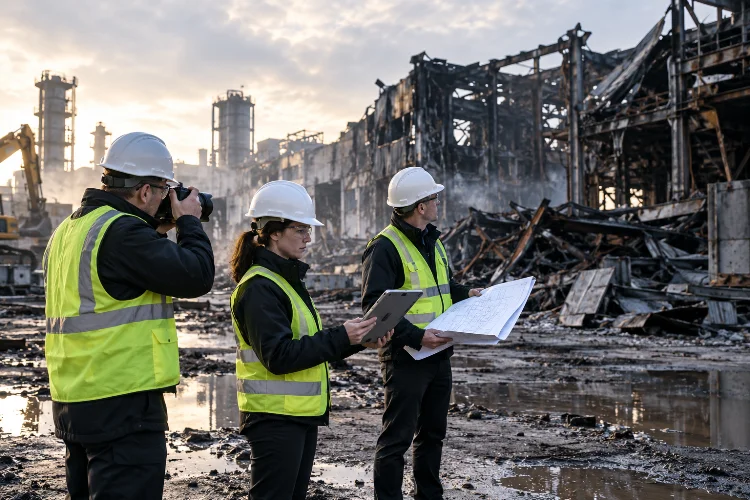
A multimillion-dollar factory fire involving business interruption, disputed liability, damaged machinery, and several insurers can take months – or even years – to fully understand.
Treating those two cases with the same investigation process would make little sense.
That is why complex claims require different investigation strategies depending on the type of loss, the evidence available, the people involved, and the potential financial consequences.
Complex claims often contain several uncertainties at once. Coverage may be unclear, liability can be disputed, damages may continue developing, fraud indicators might appear, and outside specialists could be needed before an insurer can estimate the real loss.
Modern claims teams therefore combine traditional investigation with data analytics, expert assessments, digital evidence, predictive tools, and specialized adjusters.
McKinsey expects complex insurance claims to continue requiring significant human judgement even as automation handles more routine cases.
The challenge is not investigating everything equally. It is knowing which questions matter most for each claim.
Complex Claims Need More Than Standard Claims Processing
Straightforward claims usually follow predictable patterns.
Coverage can be verified, damage assessed, documents reviewed, and payment calculated with relatively little uncertainty.
Complex cases are different.
A single file may contain questions about causation, liability, policy interpretation, medical treatment, future losses, fraud, litigation, or multiple responsible parties.
Consider a warehouse fire.
Investigators may need to determine where the fire started, whether equipment failed, whether safety procedures were followed, how much inventory was destroyed, and whether the business interruption calculation is reasonable.
The insurer may require engineers, forensic accountants, fire investigators, lawyers, and claims specialists to answer those questions.
Digital technology can help organize this information, but it does not remove the need for expert analysis.
McKinsey notes that complex claims such as injury and litigation cases will continue to depend heavily on human judgment, supported by technology that can summarize information and improve decision-making.
Bodily Injury Claims Require Medical and Liability Investigation
Bodily injury claims can look relatively simple immediately after an accident.
Then the medical picture changes.
An injured person may require additional treatment, surgery, rehabilitation, or long-term care. Some injuries can also affect future employment and earning ability.
Investigators therefore need to examine more than the initial medical bill.
They may review medical records, accident reports, witness statements, employment information, treatment patterns, and expert assessments.
Liability must often be investigated separately.
For example, a commercial vehicle accident could involve the driver, employer, vehicle maintenance company, road conditions, or another vehicle.
Future Costs Can Be More Important Than Current Costs
A complex injury claim might have relatively modest expenses during the first month but significant future exposure.
Claims specialists therefore need to understand probable medical development rather than simply adding up existing invoices.
Analytics can support that process by highlighting unusual treatment patterns or comparing a case with similar historical claims. However, medical context still requires human interpretation.
The investigation strategy therefore combines clinical evidence, liability analysis, financial estimation, and regular reassessment as the claimant’s condition develops.
Large Property Claims Depend on Forensic Evidence
Property claims require a completely different investigative approach.
After a major fire, explosion, flood, or structural failure, investigators need to understand both what was damaged and why the damage happened.
Causation can determine whether coverage applies and whether another party may ultimately be responsible.
Engineers might inspect structural damage. Fire investigators could examine ignition sources. Equipment specialists may determine whether machinery failed before or because of the incident.
Documentation is equally important.
Photographs, surveillance footage, maintenance records, invoices, building plans, weather information, and sensor data can all contribute to the investigation.
Technology increasingly helps insurers analyze this material. The NAIC notes that AI is already being used in insurance claims to analyze accident images, estimate repair costs, assess damage, and support ultimate settlement estimates.
For large losses, however, a model-generated estimate is only one piece of the investigation.
Physical inspection and specialist judgement remain critical.
Business Interruption Requires Financial Investigation
A damaged building is usually visible.
Lost business income is not.
Commercial property claims frequently include business interruption coverage designed to compensate an insured company for income lost while normal operations are disrupted.
Calculating that loss can become complicated.
Investigators may need to examine historical revenue, seasonal patterns, profit margins, payroll, inventory, projected growth, saved expenses, and the period reasonably required to restore operations.
A company cannot simply claim that every reduction in revenue after a fire resulted from the fire.
Suppose sales were already declining six months before the event. A forensic accountant may need to separate the effect of the insured loss from existing business trends.
This makes financial investigation fundamentally different from physical damage assessment.
The strongest strategy usually combines accounting records with operational information so investigators can reconstruct what the business would probably have earned if the loss had never occured.
Suspected Fraud Requires a Targeted Investigation
Fraud introduces another type of complexity.
A legitimate loss and a fraudulent one may initially look very similar.
Fraud can involve a completely fabricated event, but it can also involve exaggeration of an otherwise genuine claim.
The NAIC distinguishes between hard fraud – such as deliberately causing a loss – and soft fraud, where legitimate losses or application information are intentionally exaggerated or misrepresented.
Investigating every claimant as though they committed fraud would be inefficient and damaging to customer trust.
Instead, insurers use targeted screening.
Predictive models, link analysis, previous claim information, relationships between parties, timing patterns, and inconsistencies in documentation can help identify cases requiring deeper investigation.
The NAIC reports that insurers increasingly use AI and predictive technology to detect or refer suspicious claims for further investigation.
A flagged case may then require interviews, document verification, specialist investigators, or examination of relationships between claimants and service providers.
The goal is evidence, not suspicion alone.
Litigation Claims Require Early Legal Strategy
Once litigation becomes likely, the investigation changes again.
Evidence needs to be preserved carefully because it may eventually be presented during legal proceedings.
Statements, photographs, correspondence, expert reports, medical documents, contracts, and physical evidence can all become important.
The claims team may also work closely with legal counsel.
An early investigation can determine whether the insurer should defend the case aggressively, pursue settlement, investigate another responsible party, or obtain additional expert evidence.
Timing matters.
Witness memories fade. Physical evidence can disappear. Vehicles are repaired, buildings are demolished, and digital information may become harder to recover.
For complex liability disputes, therefore, the first few weeks can shape what happens years later.
McKinsey specifically identifies litigation risk as one of the characteristics that can be used to route complicated claims toward specialized human handling rather than automated processing.
That early routing helps prevent legally sensitive cases from sitting too long inside ordinary claims queues.
Cyber Claims Need Technical Investigation
Cyber claims represent a very different challenge because much of the evidence is digital.
After a ransomware attack, investigators may need to determine how attackers entered the network, which systems were compromised, what information was accessed, and how long the attackers remained inside.
The insurer may need cybersecurity specialists, forensic IT teams, privacy lawyers, breach-response experts, and business interruption specialists.
Logs, authentication records, network traffic, backups, emails, and endpoint data can become crucial evidence.
Timing is especially important.
Digital evidence can change quickly, while continuing unauthorized access may increase the loss.
The claim may also involve several different coverage components, including data restoration, business interruption, ransom-related expenses where permitted, third-party liability, and regulatory costs.
A traditional property adjuster would not necessarily have the technical expertise required to investigate these issues.
Cyber claims show why specialization matters so much in modern claims operations.
Multiple Parties Make Liability Investigations Harder
Some claims become complex because too many parties are involved.
Imagine a building collapse during construction.
Potentially responsible parties might include the property owner, architect, general contractor, engineering firm, subcontractors, material suppliers, and equipment manufacturers.
Determining responsibility requires reconstructing who did what.
Contracts need to be examined. Engineering evidence must be reviewed. Project records, emails, inspection reports, and site photographs may become important.
Insurance investigators also need to consider subrogation.
If another party caused the loss, the insurer that pays its policyholder may later attempt to recover money from the responsible party.
AI is increasingly being explored for claims functions including subrogation, document processing, and liability detection, according to NAIC research on insurer adoption of AI and machine learning.
Identifying recovery opportunities early can materially reduce an insurer’s net claim cost.
Catastrophe Claims Require Scale Rather Than Maximum Detail
A hurricane can generate tens of thousands of claims almost simultaneously.
Investigating every property using the same intensive process applied to a multimillion-dollar commercial fire would overwhelm any claims organization.
Catastrophe investigation therefore requires segmentation.
Relatively straightforward damage may be assessed remotely using photographs, video inspections, aerial imagery, or other digital tools.
Severe or unusual losses can then be routed toward field adjusters and specialists.
This creates a tiered investigation model.
McKinsey describes future catastrophe claims environments where satellite information, drones, connected devices, weather data, and other digital sources can help insurers estimate losses and prioritize response after major events.
The purpose is not to remove investigation.
It is to concentrate detailed investigation where uncertainty and potential financial exposure are highest.
Data Analytics Helps Decide How Deep to Investigate
Perhaps the biggest improvement in modern claims investigation is the ability to determine which cases deserve additional scrutiny earlier.
AI can analyze large quantities of structured and unstructured information much faster than an individual adjuster.
The NAIC reported in April 2026 that insurers use AI for claims functions including image analysis, settlement-value estimation, and fraud detection. Its insurer surveys also show broad interest in AI and machine learning across property and casualty operations.
This makes investigation more selective.
A well-documented low-risk claim might move toward rapid resolution.
A claim showing unusual medical development, suspicious relationships, large potential severity, or disputed liability could automatically receive a deeper review.
But analytics should support rather than blindly control decisions.
The NAIC emphasizes that insurers remain responsible for accuracy, fairness, compliance, and human oversight when AI influences insurance decisions.
That matters because unusual claims are exactly where historical models can be least reliable.
Experienced Investigators Still Matter
Complex claims often contain ambiguity that cannot be solved simply by adding more data.
A witness may contradict another witness.
An engineer may disagree with the insured’s expert.
Medical records might not clearly establish whether an injury resulted from the accident.
Experienced claims professionals need to interpret those conflicts.
They also need communication and negotiation skills.
A technically accurate investigation can still produce a poor outcome if the insurer cannot explain its reasoning, coordinate specialists, or negotiate effectively with claimants and attorneys.
This is why claims technology is more likely to change the investigator’s job than eliminate it.
Routine document review, data extraction, image analysis, and administrative work can increasingly be automated.
People can then concentrate on causation, negotiation, coverage interpretation, expert coordination, and unusual circumstances.
That division of work makes investigations both faster and more thourough.
Investigation Strategies Must Keep Evolving
Complex claims rarely stay exactly as they appeared on day one.
New medical information emerges. Additional property damage is discovered. Litigation begins. Another responsible party is identified.
Investigation therefore needs to remain dynamic.
A claim originally classified as routine may suddenly require specialist intervention.
Conversely, a potentially complicated claim might become easier once liability and damages are clearly established.
Modern claims systems increasingly support this continuous reassessment.
NAIC information on insurtech notes that digital tools, AI, connected devices, and automation are changing how insurers handle claims while increasing expectations for faster and more personalized service.
The strongest investigation strategy is consequently not a rigid checklist.
It is a process that changes as the evidence changes.
Complex claims require different investigation strategies because complexity can come from very different sources.
A severe injury needs medical and liability expertise, a factory fire may require engineers and forensic accountants, suspected fraud needs targeted investigation, and a cyberattack demands technical digital forensics.
Trying to handle every case through the same process wastes resources and can produce inaccurate outcomes.
Technology now helps insurers identify complexity earlier, analyze evidence faster, and route cases toward appropriate specialists. Still, human judgement remains essential when causation, liability, coverage, or damages are uncertain.
For claims leaders, the priority should be matching the depth of investigation to the actual risk. Build processes that identify complexity early, preserve evidence quickly, and bring the right expertise into the case before problems become harder – and more costly – to resolve.
